The Knights Templar were a monastery, an army, and a bank, all at once, for almost two hundred years. Then, on a Friday in October 1307, the King of France had every Templar in the country arrested before breakfast, and seven years later the last Grand Master was burned on an island in the Seine. An institution that rich and that secretive doesn't get to vanish quietly. It gets a conspiracy theory for every century that follows, and a novel for every conspiracy theory.
I spent three years with the Order while writing Book 6 of my series, and most of that time I was reading. A lot of Templar fiction is bad in the same way: white mantles, red crosses, a lost treasure, a hooded villain. The ten below are the ones that found something truer. Dan Brown isn't on the list, not out of snobbery; he's just the reason you already know what a Templar is.
1. Jerusalem by Cecelia Holland (1996)
Rannulf Fitzwilliam is a Templar knight of no birth and less charm, serving in the last years of the Kingdom of Jerusalem: the leper king dying by inches, the barons fighting over his succession, and the road that ends at the Horns of Hattin in 1187. Holland writes the Templars as they almost certainly were, a house of violent, devout, damaged men who had nowhere else to go and knew it.
The prose is stripped to the bone and she refuses to flatter anyone, which is why the ending lands so hard. This is the best novel ever written about what it felt like to be inside the Order, and it is nearly impossible to find in print. Find it anyway.
2. The Road to Jerusalem by Jan Guillou (1998)
Arn Magnusson is a Swedish nobleman's son, raised by monks, who is sentenced to twenty years as a Templar for the crime of loving the wrong woman. The first book takes him to the gates of the Order; the second, The Knight Templar, sends him to Outremer, where he spends two decades fighting and ends up face to face with Saladin.
Guillou sold millions of these in Scandinavia and the English translations finally arrived in 2009. What makes them work is Arn's training: he is a monastery-made fighter, and the books take seriously the idea that a Templar was a monk first. The 2007 film is decent. The books are better.
3. The Iron King by Maurice Druon (1955)
The curse, told from the throne room. In 1314 Jacques de Molay burns in Paris and calls Philip the Fair and Pope Clement V to meet him before God within the year. Both die. Druon takes that legend and runs it through seven novels about the rotting of the French monarchy that follows, and the first one is the best.
George R. R. Martin has said this is the original Game of Thrones, and for once the blurb is accurate. Druon's Templars are mostly off the page, already destroyed, and that is the point: the book is about what a king becomes once he has learned he can erase an order of the Church for its money.
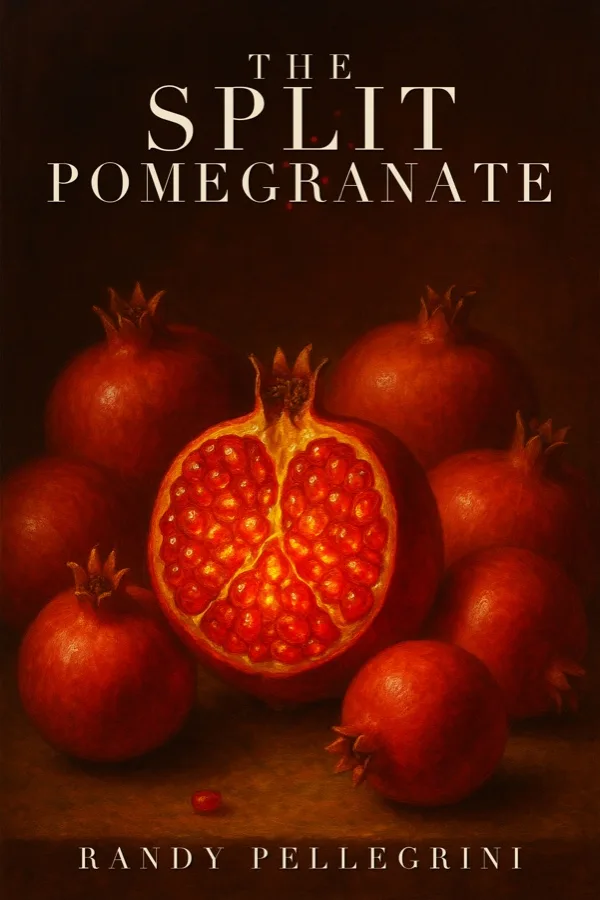
4. The Split Pomegranate by Randy Pellegrini (2026)
Mine. And my Templar is a mason, not a knight.
Brother Guilhem of Carcassonne builds for the Order in the Holy Land. He can lay a hand on worked stone or metal and know the maker, the year, the flaw waiting inside it. Across the lines of the Second Crusade's siege of Damascus he meets Eschiva bint Yehiel, a Jewish engineer who keeps the city's hidden water and can do the same impossible thing. What follows is a love carried for twenty years in letters and coded seals, while the Order that shelters Guilhem moves to turn an ancient inheritance into a registry of bloodlines it can own. It runs from 1140 to the fall of Jerusalem in 1187.
I wrote it because the Templars built as much as they fought, and nobody writes the builders. It's Book 6 of The Architecture of Survival and it stands entirely on its own.
5. Ivanhoe by Walter Scott (1819)
Brian de Bois-Guilbert, the Templar who wants Rebecca of York and will burn her as a witch if he can't have her, is the first great Templar in fiction and still one of the best. Scott gives him real courage and real feeling and then lets the Order's politics make him a monster anyway, which is a more interesting idea than most of the thrillers below ever reach.
Yes, it's long, and yes, the tournament chapters go on. Skip to Templestowe if you must. The trial scene at the preceptory, with the Order's own rules used to condemn an innocent woman, is where two centuries of sinister-Templar fiction begin.
6. Brethren by Robyn Young (2006)
Will Campbell is a Templar sergeant in the 1260s, hunting a heretical book stolen from the Order's vaults while Sultan Baibars takes the crusader fortresses apart one by one. Underneath the Temple is a secret brotherhood, the Anima Templi, working toward a peace nobody above them wants. First of a trilogy that ends at the fall of Acre.
I put this on my Crusades list too, and it belongs on both. Young's Mamluk chapters are better than her Templar ones, which I mean as a compliment, and she is one of the few writers who understands that the Order's final decades were a long, grinding loss.
7. Knights of the Black and White by Jack Whyte (2006)
The founding, as a secret. Hugh de Payens, the historical first Grand Master, is here a young Burgundian knight inducted into a hidden brotherhood that believes something dangerous lies buried under the Temple Mount. He rides on the First Crusade with two missions, one of them unspoken, and the Order is born out of the digging.
Whyte wrote the Camulod books and brings the same plain, physical style to the eleventh century. The secret-society frame is pure speculation, but he does the honest thing and keeps the speculation inside the heads of men who could have believed it.
8. Foucault's Pendulum by Umberto Eco (1988)
Three bored editors at a Milan publishing house start feeding occult manuscripts into a computer and assembling "The Plan," a grand Templar conspiracy stitched together from every crank theory they've ever rejected. Then people who believe in the Plan start showing up.
It is the funniest book on this list and the most frightening, because Eco understood the Templar myth from the inside: the Order's real secret is that it had no secret, and that vacuum is exactly what people fill. Read it after the thrillers below and you will never read them the same way again. If you liked The Name of the Rose, I have a separate list for that.
9. The Last Templar by Raymond Khoury (2005)
Four horsemen dressed as Templar knights ride into the Metropolitan Museum of Art during a Vatican treasures gala, take one object, and leave. An FBI agent and an archaeologist follow the trail back to 1291 and a Templar fleeing the fall of Acre with something the Order needs to survive.
This is the airport version, and it's a good one. If you want the same ride with more Rennes-le-Château, Steve Berry's The Templar Legacy came out the next year. Khoury's medieval chapters are the reason to read his.
10. The Last Templar by Michael Jecks (1995)
Same title, different book, and the one I'd hand to anyone who's tired of lost treasure. Sir Baldwin de Furnshill comes home to Devon in 1316 having survived the Order's destruction, and he is not going to talk about it. A bailiff named Simon Puttock needs help with a burned body, and a thirty-book mystery series begins.
Jecks's Baldwin is a Templar in the aftermath: a man whose whole adult life was declared a heresy, trying to live quietly in a county that doesn't know what he was. That is the Templar story almost nobody tells, and it took a village-mystery series to tell it.
Why the Templars Keep Coming Back
The Order left behind rules, rolls, trial transcripts, and a great many stone buildings, and almost nothing about what any individual Templar actually thought. That gap is where the fiction lives. The thrillers fill it with treasure; the better novels fill it with people who had to be monks and soldiers at the same time and were never going to be good at both.
I filled it with a man who built the walls and wondered what they were for.