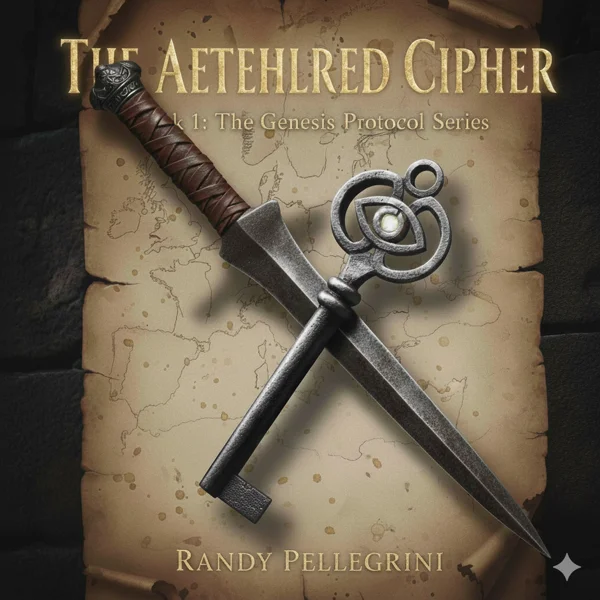
The Black Death is a year from Mainz. In the monastery of St. Martin, a young scribe named Thomas walks into the copying room with his breakfast and finds his teacher bleeding at the desk. This is the whole first chapter, exactly as it appears in the book.
1347, St. Martin’s Monastery, Mainz
Blood and ink.
The smell hit Thomas first, sharp and metallic beneath the acrid bite of smoke from overturned candles. Brother Hamo lay sprawled across the copying desk, his robes dark with spreading crimson. The manuscript he’d been working on, a commentary on Boethius, was spattered, blood soaking into the vellum.
Thomas froze in the doorway. Breakfast bread forgotten in his hand.
“Hamo?”
The old monk’s hand twitched. Thomas dropped the bread and knelt beside him.
“Thomas.” Hamo’s voice bubbled wetly. A narrow wound gaped in his chest, precise as a scribe’s cut. The dagger was gone. “Took… too long…”
“The infirmarian—I’ll fetch—”
“No.” Hamo’s grip seized Thomas’s wrist. “They’re coming. The Gray Robes.”
“Who—”
“The Order.” Blood flecked Hamo’s lips as he coughed. His other hand fumbled in his robes, pulled out something small. Iron. “Your grandfather… Wilhelm… he made me swear. If anything happened… this goes to you.”
He pressed the object into Thomas’s palm. A key, crude iron, with an eye symbol etched into the handle.
Thomas stared. “I don’t understand—”
“The cipher. The marks in the margins. Wilhelm’s network.” Hamo’s eyes drifted, then sharpened again with effort. “This is the only tool that can read it. They’ve done this before, Thomas. Plague of Justinian. Same pattern. They knew this plague was coming—positioned their people, let millions die. Wilhelm found the proof.” Blood bubbled at his lips. “The Order will kill anyone who knows. You must—”
Footsteps in the corridor. Multiple sets. Heavy boots, not sandals.
Terror transformed Hamo’s face. “Go. The tunnels beneath the wine cellar. Now!”
“I won’t leave you—”
“You’re weak, Thomas. Everyone knows it. Weak at digging, weak at hauling, weak at everything that matters.” Hamo smiled, sad and certain. “But Wilhelm saw something in you. Some gift.” Blood ran from the corner of his mouth. “If he believed it… then I believe it too.”
The footsteps drew closer. Calm voices, methodical, asking questions in the chapter house.
“Go,” Hamo whispered. “See the patterns your grandfather saw. Make my death—”
His eyes went distant. His hand went slack.
Thomas knelt there, the iron key cutting into his palm.
The voices reached the cloister.
“—the scribe boy, Thomas of Eltville. Where is he?”
“—Brother Hamo was the last to see the manuscript—”
“—search the scriptorium first—”
Thomas looked at Hamo’s body. At the ruined Boethius. At the key in his hand.
Grandfather Wilhelm had died for this. Now Hamo.
The footsteps turned toward the scriptorium.
Thomas ran.
Left at the refectory, down the stone stairs, past the chapter house. He knew these corridors, had scrubbed them often enough during penance. Shouts erupted behind him, no longer bothering with stealth.
The wine cellar was dark, cool, smelling of earth and fermentation. Squeezing between the large barrels, Thomas found the tunnel entrance Hamo had mentioned, a low arch behind the oldest cask, barely visible in shadow.
He dropped to his knees and crawled into darkness.
Behind him, the cellar door crashed open.
“—saw him come this way—”
“—check behind the barrels—”
Thomas crawled faster, hands scraping stone, the key clutched tight enough to draw blood. The tunnel sloped down and turned, opening into a larger passage of old Roman construction, forgotten when the monastery was built centuries ago.
Voices echoed behind him, but the tunnel was too narrow for a grown man in armor.
“Get the boy from the village. Someone who can fit.”
Thomas didn’t wait. He ran through darkness, one hand on the tunnel wall, until light appeared ahead: a grating opening onto the city streets.
He pushed through and emerged in an alley reeking of offal and the tanning vats.
Free—for now.
Thomas opened his palm. Blood on the key. His own, from the sharp edges. Or Hamo’s, from those final moments.
Your grandfather saw something in you.
Hamo saw it too.
And they both died for it.
But he was alive. The Gray Robes wanted this key badly enough to kill for it.
Pulling his hood up, Thomas stepped into the crowded streets of Mainz. Plague bells rang their hollow rhythm. Somewhere beyond the market square, someone screamed.
Hamo’s dying words echoed: They knew this plague was coming.
Not foretelling. Contriving.
Thomas stumbled into an alley and pressed his back against cold stone. The key cut into his palm.
Wilhelm’s lessons echoed: “You see patterns, Thomas. That’s worth more than strong arms.”
And his deathbed words: “Scatter their knowledge like seed on wind. Across generations, scattered knowledge distributes power.”
Now those words made terrible sense.
The Order: Gray Robes who controlled knowledge, accumulated power through breeding and secrets, and seemed to know catastrophes before they happened.
And the Network: Wilhelm’s network, scattered families who believed knowledge should be distributed, not hoarded.
Both claimed to preserve civilization. Somewhere across centuries, they’d become enemies.
Wilhelm had been Network. Hamo’s killers were Order.
Then I’d better start seeing the patterns.
The cloth merchant’s quarter sprawled like a maze: drying racks casting latticed shadows, funeral shrouds hanging limp in the still air.
Thomas moved through it like a ghost, his monk’s robes stained with tunnel filth. The smell here was different from the alley: lye soap cutting through decay, wet wool drying in weak sunlight, and underneath it all, the sweet-sick odor of bodies waiting to be wrapped.
A woman worked at a sorting table, hands moving with numb precision through plague-stained linens. The clothes of the dead.
Thomas started to turn away.
“You’re bleeding,” she said without looking up.
Thomas examined his palm. The key had cut deeper than he’d thought. “It’s nothing.”
“Infection kills as surely as plague.” She looked up.
Younger than he’d expected. Mid-twenties, perhaps. Sharp face, intelligent eyes, a scar running along her jawline. Her hands, though working with fabric, were callused in ways that spoke of harder work than cloth.
“The Gray Robes are watching the gates,” she said, returning to her work. “Whatever you stole, they want it back. Three men just came through here asking about a scribe boy. I told them I saw you heading toward the cathedral.”
“Why would you—”
“Because the Order killed my father for having books they didn’t approve of.” Her voice was flat. “I don’t help them. Ever.”
Thomas stepped closer. “The books. Did they have… marks? Patterns in the margins?”
Her hands stilled. For just a moment, her mask cracked. “Who are you?”
“Thomas. Of Eltville.”
“Eltville.” She tested the name. “Wilhelm’s grandson?”
His breath caught. “You knew him?”
“My father knew him. Worked with him.” She studied Thomas with new intensity. “You look like him. Same soft hands. Same naive eyes that think the world should be fair.”
“I don’t—”
“Good. Because it’s not.” She pulled a strip of cloth from her pile and walked around the table. “Give me your hand.”
Thomas hesitated, then extended his bleeding palm.
She bound the wound with efficient movements. This close, he could smell rosemary, lavender, and something acrid: the mordants used in cloth dyeing. Or erasing ink.
“The river path,” she said, tying off the bandage. “Go before dark. There’s a warehouse district. Third building, red mark on the door. Knock twice. If I’m not there by morning, run south and don’t look back.”
“I don’t even know your name.”
“Margarethe.” She met his eyes directly. “And if you’re carrying what I think you’re carrying, Thomas of Eltville, knowing my name might be the most dangerous thing you ever learn.”
She turned back to her work, dismissing him.
Thomas walked toward the river, his bandaged hand throbbing. He looked back once.
Margarethe was watching him, unflinching.
For reasons he couldn’t name, his chest tightened.
Margarethe’s hands shook as she returned to sorting linens.
Wilhelm’s grandson.
Memory came unwanted: Seven years ago. Her father’s warehouse. Brother Anselm standing over Heinrich’s broken body, asking questions with calm precision.
“Where is the index, Heinrich?”
“There is no… master list…”
“We know about the network. The cipher maps. Wilhelm hides behind monastery walls, but his knowledge travels.”
Margarethe, hidden in the loft, had bitten through her lip.
Her father looked up—directly at her hiding place. Their eyes met.
Don’t speak. Don’t move. Live.
Then: “I’ll tell you. The index is in… Abbey of Fulda. Behind the altar stone—”
Anselm’s dagger had been quick. Merciful.
The lie saved her. There was no index at Fulda. The real locations were in her father’s head, and he’d spent her childhood teaching her to memorize them. Two hundred and seventeen locations. The complete network.
She was the index. The living catalog.
And she’d just revealed herself to Wilhelm’s grandson.
But when she’d seen Thomas’s eyes, that same naive belief her father had, she’d seen all the good men the Order had murdered.
Maybe this time, she’d be fast enough to save one.
Margarethe locked her shop and strapped her daggers beneath her cloak. Her father’s blades.
If Wilhelm’s grandson was carrying the cipher key, the Order would hunt him properly.
And Thomas of Eltville would be dead by nightfall unless someone kept him alive.
1347, Night. River Path.
Thomas followed the path along the Rhine, the water black and cold beside him. Behind him, the city bells tolled for the dead. Another plague cart rattling through the streets.
He’d made it perhaps half a mile when he heard the footsteps.
Two sets. Heavy boots on cobblestones. Not bothering to hide.
Thomas’s heart hammered. He walked faster. The footsteps matched his pace.
“Scribe boy!” A voice called behind him. “Brother Anselm would speak with you. No need to run.”
Thomas ran.
The river path narrowed. Warehouses loomed on one side, the drop to the water on the other. Thomas’s sandals slipped on wet stone, his breath coming in ragged gasps.
A hand grabbed his shoulder and yanked him back. Thomas spun, fell, hit the cobblestones hard. Stars exploded across his vision.
“Easy now,” the first man said. He wore the gray robes, the silver key pendant. “We just want the little iron toy you’re carrying. Give it over, and maybe you live to copy another psalm.”
The second man drew a dagger. “Or don’t, and save us the trouble.”
Thomas’s hand closed around the key in his pocket. Hamo’s blood was probably still on it. Grandfather’s legacy.
“No,” he whispered.
“What was that?”
“I said no.” Louder now. “You killed my grandfather. You killed Hamo. You’re not getting this.”
The first man sighed. “Brave and stupid. The worst combination.” He nodded to his partner. “Make it quick.”
The dagger came toward Thomas’s throat.
And stopped.
The second man made a strange gurgling sound, looked down at the blade protruding from his neck, confused. Then he collapsed.
The first man spun, reaching for his own weapon—
Margarethe rose from the shadows behind him, a second dagger already in motion. She drove it under his ribs with practiced precision, twisted, withdrew. The man fell.
Thomas stared from his position on the ground, ears ringing. The world narrowed to Margarethe standing over the bodies, wiping her blades on the first man’s cloak.
She looked at Thomas. Calm. Practiced.
“Breathe,” she said. “Unless you want to faint and crack your skull.”
Thomas breathed. The ringing subsided.
Margarethe sheathed her daggers and extended a hand. Her grip was strong, callused. She pulled him to his feet.
“You were supposed to go to the warehouse,” she said.
“I was going—”
“Too slow. The Order doesn’t just guard gates. They watch the paths too.” She looked at the bodies without emotion. “I followed you. Figured you’d be dead within the hour if I didn’t.”
“You’ve been following me since—”
“Since you left my shop. Aye.” She checked the alley behind them. “These two won’t be the last. Can you run?”
“Yes.”
“Then run. Toward the warehouses. Third door, red mark. I’ll make sure no one else is tracking you, then meet you there.”
“Wait—” Thomas found his voice. “You killed them.”
“Aye.”
“You just… killed two men.”
“Would you prefer I let them kill you?” Her tone was matter-of-fact, but something flickered in her eyes. “This isn’t the scriptorium, Thomas. Out here, you either run or you bleed. Sometimes both.”
She turned to leave.
“Thank you,” Thomas said.
Margarethe paused. Didn’t turn around. “Don’t thank me yet. You’re not safe. Neither of us is.” A beat. “But I owed your grandfather a debt. I pay my debts.”
“Is that the only reason you helped me?”
Now she did turn. Looked at him directly. “I don’t know. Ask me again when we’re not standing next to corpses.”
She disappeared into the shadows.
Thomas ran for the warehouse, fear and the rush of his own blood driving him forward.
Thomas found the warehouse. Third building. Red mark painted on the door. He knocked twice.
Silence.
He waited. Minutes dragged. Every shadow became a gray cloak.
The door opened. Margarethe stood there, still wearing the same bloodstained dress. She’d made no effort to clean it.
“Inside. Quick.”
The warehouse was vast and cold. Bales of fabric rose like monuments in the gloom. A single lantern burned on a makeshift table.
Margarethe locked the door behind him, all three bolts, then turned, arms crossed, and studied him.
“Sit.”
Thomas sat on a crate, legs grateful for it.
Margarethe didn’t sit. She circled him slowly, like a merchant appraising wares.
“You’re a terrible liar,” she said finally.
“I didn’t lie—”
“You’re afraid. Of me, of the Order, of yourself. That’s honest.” She stopped in front of him. “But you’re hiding something. Everyone does. So here’s how this works: I ask questions, you answer truthfully, and maybe we both survive the week. Lie to me, and I throw you out. Clear?”
Thomas nodded.
“Name.”
“Thomas. Thomas of Eltville.”
“Family.”
“My father is alive. In Eltville. We… don’t speak. He wanted me in the vineyards. I was too weak for it.” The admission hurt. “My grandfather raised me. Wilhelm.”
“How did he die?”
“The Order killed him. I didn’t know it then. Thought it was a fever. But I saw the man who visited the day before. He wore a silver key.”
Something softened in Margarethe’s expression. Not much. But enough.
“Your grandfather was brilliant,” she said quietly. “Reckless, but brilliant. My father said Wilhelm could hold an entire library in his head. Memorize every location, every cipher mark, every hidden text.” She paused. “Did he teach you?”
“Some. He showed me how to see patterns. How to remember sequences. But I was young. I didn’t understand…” Thomas pulled out the iron key. “Until Hamo gave me this.”
Margarethe’s breath caught. She reached for the key, then stopped herself. “May I?”
“Aye.”
She took it gently, reverently, turning it over in her hands, examining the etched eye symbol.
“I thought this was lost,” she whispered. “When my father died, Anselm searched for weeks. He tore apart our warehouse, our home. He never found it.”
“Because Wilhelm had it?”
“Wilhelm kept it separate. Safe.” She looked up at Thomas. “Do you know what this is?”
“Hamo said it reads the cipher. Shows which dots matter.”
“It’s more than that.” Margarethe pulled a folded piece of parchment from her bodice and spread it on the table.
Thomas leaned forward. The parchment showed what looked like a manuscript page, covered in dense Latin text. But in the margins, faintly visible, were geometric dot patterns.
Margarethe placed the iron key over the page. The eye symbol aligned with a specific section of text. Through the aperture, certain dots were highlighted.
“The key is a template,” she explained. “Position it correctly, and it tells you which dots to count, which to ignore. Without it, the cipher looks like scattered dots. With it…” She counted quickly. “Abbey of St. Gall. Third shelf. Volume on Aristotelian comedy.”
Thomas stared. “Madness. Those dots—they’re tiny. Mere chance—”
“Not scattered. Never by chance. Every mark has meaning. Position, color, depth. It’s a language, Thomas. A mathematical language your grandfather helped create.” She handed the key back. “And now you’re holding the only tool that exists for reading it.”
“Why not make more?”
“Because more copies mean more chances for the Order to find one. This key is unique. The knowledge of how to make it died with the original architects.” Margarethe’s jaw tightened. “My father tried to recreate it. He couldn’t. The mathematics were beyond him. Beyond anyone alive.”
Thomas turned the key over in his hands. Such a small thing. Iron, worthless. But it held the power to unlock centuries of hidden knowledge.
“What do we do with it?” he asked.
“We?” Margarethe raised an eyebrow.
“You saved my life. You clearly care about protecting this cipher. I have the key, but I don’t know how to use it properly. You know the system, but you don’t have the tool.” Thomas met her gaze. “Separately, we’re incomplete. Together…”
“Together we’re bigger targets.”
“Perhaps. Or perhaps we’re strong enough to actually do something with this.”
Margarethe looked at him a long moment. “You’re naive.”
“Aye.”
“Weak. Probably useless in a fight.”
“Almost certainly.”
“And you think because we share a dead man’s legacy, that makes us allies?”
“I think,” Thomas said carefully, “that you could have let those men kill me. You could have taken the key off my corpse and been done with it. But you didn’t. So either you’re a worse pragmatist than you pretend, or…” He trailed off.
“Or?”
“Or you’re just as tired of being alone as I am.”
The silence stretched between them. The lantern flickered.
Finally, Margarethe sat on a crate across from him. “Here’s what you need to understand, Thomas of Eltville. Everyone I protect dies. My mother. My father. The merchants who worked with him. The Order doesn’t leave loose ends.”
“But you’re still alive.”
“Because I’m careful. Because I trust no one. Because I’ve made myself useful enough to too many people that killing me would cause problems.” She leaned forward. “You want to be allies? Very well. But don’t mistake alliance for friendship. Don’t expect me to save you again. And don’t—” Her voice caught slightly. “Don’t ask me to care whether you live or die. Because everyone I care about ends up dead.”
Thomas heard what she tried to bury: grief, and something close to fear.
“I won’t ask,” he said softly. “I’ll try not to get killed, anyway. Can’t promise about the caring part.”
“What?”
“I already care whether you live or die. You saved my life. That tends to create attachment.”
Margarethe stared at him. Then, unexpectedly, she laughed, sharp and bitter. “You’re going to be a problem, aren’t you?”
“Probably.”
She shook her head, but something in her expression had shifted. “We start tomorrow. I’ll teach you to read the cipher properly. You’ll teach me everything your grandfather told you about the network. And we’ll figure out what to do with this damned key before the Order finds us.”
“Where do I sleep?”
“There.” She pointed to a pile of wool blankets in the corner. “I’ll be on the other side of the warehouse. If you try anything, I have more daggers.”
“I wouldn’t—”
“I know. You’re too naive to be dangerous.” But she almost smiled. “Sleep, Thomas. Tomorrow we find out if you’re really Wilhelm’s grandson or just another dead scribe waiting to happen.”
She walked into the shadows, leaving Thomas alone with the lantern and the weight of his grandfather’s legacy.
He lay on the wool blankets, the key pressed against his chest.
For the first time since Hamo’s death, he felt something other than fear.
He felt purpose.
Tonight, he just needed to survive.
That's the end of Chapter 1. Thomas has the key. The Order knows he has it.
Keep reading on Amazon →Free to read with Kindle Unlimited · Audiobook available · Every book in the series stands alone.