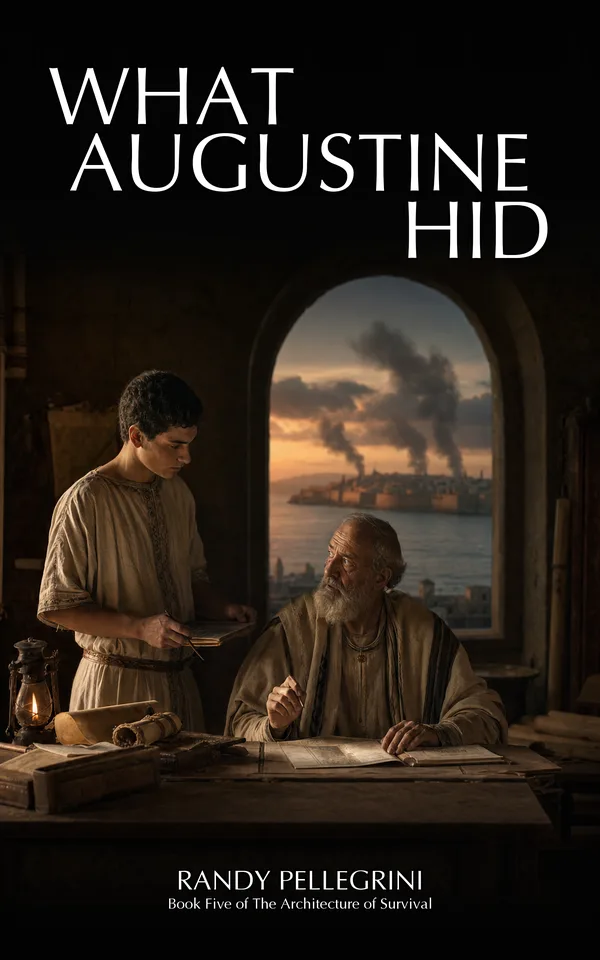
Book 5 of The Architecture of Survival
What Augustine Hid
Augustine of Hippo hid something inside his most famous book — and the world has been carrying it for sixteen hundred years without knowing.
Free to read with Kindle Unlimited. Every book in the series stands alone.
About the Book
The year is 410 CE. Augustine of Hippo is fifty-six years old, twenty-three years a bishop, and the most consequential intellectual of the late Roman world. When a dying courier is dropped at his basilica gate carrying a hidden papyrus older than the empire itself — a document that has predicted, with terrible accuracy, the fall of every civilization before Rome — Augustine recognizes the handwriting of the network his mother taught him to watch for, the one he has been carrying a piece of bronze for since the night she died at Ostia.
He has thirty years before the Vandal armies cross the strait. Thirty years to hide what cannot be lost, to write a book that will outlive empire, and to test which of the men in his household is the one the work is meant for — while reckoning with the choices that come with being the bishop the state uses to enforce its will.
What Augustine Hid is a novel about how knowledge survives the end of the world — not in marble libraries, but in the spines of codices, in the silences between bishops who know each other's secrets, in a single sentence quietly woven into a book the Church will copy for a thousand years.
Get series updates
Subscribe for new releases and behind-the-scenes updates from The Architecture of Survival series.
No spam. Unsubscribe anytime.