The Historian is a vampire novel in which almost nobody gets bitten. Six hundred pages, three generations, half the libraries of Eastern Europe, and the vampire himself is mostly a rumor in the margins. That's why people who hated Twilight loved it, and why people who wanted a vampire novel threw it across the room. Kostova's actual subject is the archive: a book with a dragon woodcut that keeps turning up in scholars' libraries, a dying mentor who hands it on, letters inside letters, and the slow realization that reading can get you killed.
I've read it three times, and the last time I was taking notes, because the first book of my series starts with the same move: a scholar dies, a document changes hands, and the person left holding it has to go find out what it means. The ten below are the books that scratch the same itch. If you haven't read Dracula itself, go read it; Kostova's novel is a long conversation with Stoker, and it's better when you can hear both sides.
1. People of the Book by Geraldine Brooks (2008)
Hanna Heath, a book conservator from Sydney, is flown to Sarajevo in 1996 to examine the Haggadah that survived the siege: a Jewish manuscript, illuminated, five hundred years old, that should never have made it out of medieval Spain. In its binding she finds a butterfly wing, a wine stain, a white hair, a bit of salt. Each one gets a chapter, and each chapter goes further back: Sarajevo 1940, Vienna 1894, Venice 1609, Tarragona 1492, Seville 1480.
Of everything on this list, this is the one that most closely shares The Historian's nervous system, a single object passed hand to hand through catastrophe. Brooks won the Pulitzer for March. This is the better book.
2. Possession by A. S. Byatt (1990)
Two scholars, a failed one and a formidable one, find the draft of a letter in a dead Victorian poet's copy of Vico and begin to suspect that two famous nineteenth-century writers had an affair nobody knows about. The investigation runs on letters, diaries, and poems, all of which Byatt wrote herself, in two separate invented Victorian voices, which is a stunt so audacious it still hasn't been matched.
It won the Booker. It's also, quietly, a thriller: there are rival academics, a stolen document, a midnight exhumation. If what you loved in Kostova was the texture of research, the archive as a place where things happen, this is the purest hit.
3. The Shadow of the Wind by Carlos Ruiz Zafón (2001)
A boy in postwar Barcelona is taken by his father to the Cemetery of Forgotten Books and told to choose one. He picks a novel by an author named Julián Carax, loves it, and discovers that someone has been systematically burning every other copy Carax ever wrote. The hunt for why takes him through the whole broken city.
Zafón sold millions of these and it's easy to see why: a gothic Barcelona, a secret library, a villain with a burned face, a love story that outlasts a war. It has the same slightly feverish, late-night quality Kostova has, and the same conviction that a book can be a dangerous object.
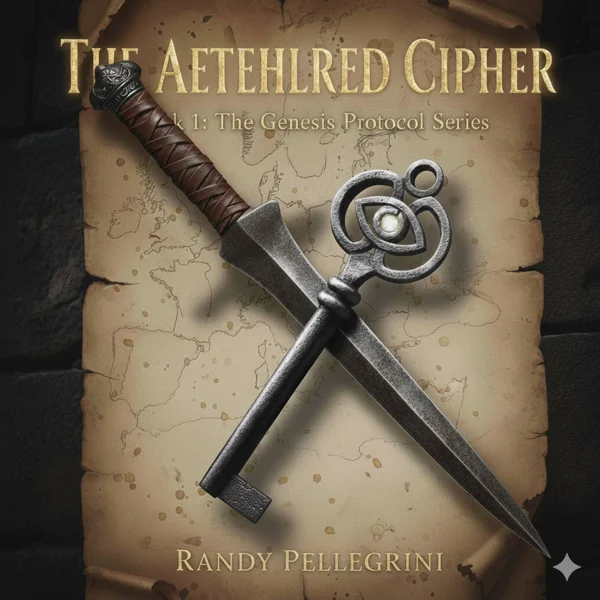
4. The Aethelred Cipher by Randy Pellegrini (2026)
Mine, and I'll tell you exactly where the Kostova is in it.
Mainz, 1347. Thomas of Eltville is a young scribe whose mentor is murdered in front of him and, dying, presses an iron key into his hands. The key unlocks a cipher hidden in the margins of manuscripts across Europe, and the cipher points to an order that has been tending human bloodlines, and human catastrophes, for a very long time. Thomas runs, with a cloth merchant whose father the Order tortured to death and a fourteen-year-old girl carrying forty generations of knowledge in her blood, while the Black Death comes up the Rhine behind them.
The dying mentor, the document that shouldn't exist, the trail through libraries, the sense that the archive is watching you back: that is the Kostova inheritance, and I took it on purpose. What I added is a cipher you can almost reconstruct and a plague that isn't a backdrop.
5. The Eight by Katherine Neville (1988)
A chess service that once belonged to Charlemagne is dug up from a French abbey in 1790 and scattered across Europe by novices fleeing the Revolution; in 1972 a computer expert in New York is sent to Algeria and starts finding the pieces. Two timelines, one object, and a code built into the board itself.
It came out seventeen years before The Historian and you can feel Kostova reading it. The 1790 chapters are the good ones. Neville gets a little loose with the history, and the 1970s plot has a Bond-film silliness, but the central idea, that a game can encode a secret worth centuries of killing, is the real thing.
6. Labyrinth by Kate Mosse (2005)
Same year as The Historian, same shape. Alice Tanner, volunteering on a dig in the Pyrenees, breaks into a cave and finds two skeletons and a ring; in 1209, Alaïs, a seventeen-year-old in Carcassonne, is handed a book her father says must never fall into the hands of the crusaders marching on the Cathars. The two women's stories close toward each other across eight hundred years.
The medieval half is much stronger than the modern half, which is the usual problem with dual-timeline books and one Mosse never quite solves. But her Carcassonne is vivid, the Cathar material is well handled, and the thing being guarded turns out to be more interesting than a grail.
7. The Club Dumas by Arturo Pérez-Reverte (1993)
Lucas Corso is a book detective, a mercenary who finds rare editions for collectors who don't ask how. He's hired to authenticate one of three surviving copies of a seventeenth-century manual for summoning the devil, and to check whether a handwritten chapter of The Three Musketeers is real. The two jobs start to bleed into each other.
Polanski filmed it as The Ninth Gate and threw away the half of the plot that matters. Pérez-Reverte's book is funnier, nastier, and much more interested in what it means to love books so much you'd kill for them. Of everything here, this is the one with the sharpest teeth.
8. The Rule of Four by Ian Caldwell and Dustin Thomason (2004)
Two Princeton seniors are a few weeks from graduation and one of them is finishing a thesis on the Hypnerotomachia Poliphili, a real, nearly unreadable Renaissance book printed in 1499 that scholars have argued about for five centuries. His father died chasing the same book. Then someone on campus is killed for it.
This was sold as a smarter Da Vinci Code and that undersold it. It's a campus novel about friendship and obsession that happens to have an actual cipher at the center, and the authors did the work: the Hypnerotomachia puzzles in the book are solvable. If Kostova's scholars felt like real people to you, so will these.
9. The Thirteenth Tale by Diane Setterfield (2006)
Vida Winter is England's most famous living novelist and has given a different fake life story to every journalist who ever asked. Dying, she summons a bookish young biographer and offers her the truth, told in order, as a bargain. What follows is a gothic about twins, a burned house, and a governess, with a story nested inside a story nested inside a story.
Fewer archives than Kostova and more atmosphere. But the structure is the same, a listener piecing a past together from testimony that may be lying, and the ending pays off every debt the book runs up. Setterfield took a decade to write a second novel, which tells you how carefully this one was built.
10. The Shadow Land by Elizabeth Kostova (2017)
If what you want is simply more Kostova, this is the one. A young American arrives in Sofia, helps an elderly couple into a taxi, and finds she's been left holding an urn of someone's ashes. Returning it means tracing the life of the man inside it, a violinist named Stoyan Lazarov, back through the Bulgarian labor camps of the 1950s.
No vampires, no dragon woodcut, but the engine is identical: a stranger's past, reconstructed from documents and the memories of people who'd rather not talk, in a country that has spent decades trying to forget. The camp chapters are the best thing she's written.
What Kostova Actually Figured Out
The trick of The Historian isn't Dracula. It's that she made research frightening: every library the characters enter is a place where someone before them read too far, and the evidence of that is still on the shelves. The ten books above all understand that a document can be a weapon, a trap, or a last message, and that the person who finds it inherits whatever it was for.
Mine opens with an iron key and a dead man who knew that.