Rome did not fall on a date. The year everyone learns, 476, is a bookkeeping entry: a Germanic general named Odoacer deposed a teenage emperor nobody had voted for and mailed the imperial regalia to Constantinople, and most people in Italy went to work the next morning. The real thing took a century and a half and happened in pieces, on the Rhine, in Britain, in Africa, in the minds of people who kept expecting the legions to come back.
That is why novelists love it. Everyone in the period is improvising. The generals are holding frontiers with no reinforcements, the bishops are running cities because nobody else will, and the barbarians are mostly men who wanted to be Roman and were told no. I have a book set in the middle of it, and I have ranked the ten below by how well they catch that feeling of a system failing while the paperwork continues.
1. Eagle in the Snow by Wallace Breem (1970)
Paulinus Maximus, a general nobody in Ravenna remembers, is sent to hold the Rhine at Moguntiacum, the city that would become Mainz, with one under-strength legion and the promise of help that never comes. On the last night of 406 the river freezes and the Vandals, Alans and Sueves walk across it. He has known for months that it will happen. The book is about what you do with that knowledge.
Breem was a frontier officer in the Indian Army before Partition, and it shows: the novel is procedural, unsentimental and precise about logistics, and it is the best thing ever written about the fall of the West. It is also, quietly, the saddest. People who have read it do not forget the ending.
2. Julian by Gore Vidal (1964)
The last pagan emperor, who ruled for twenty months in 361 to 363, tried to turn the empire back from Christianity, and died on campaign in Persia with a spear in his side that may have been Roman. Vidal tells it through Julian's own memoir and the bickering marginal notes of two old philosophers, Libanius and Priscus, who knew him and cannot agree about him.
It is the funniest book on this list and the only one that treats the triumph of Christianity as the fall. Vidal's Julian is brilliant, priggish and doomed, and the letters that frame his story are a masterclass in how two witnesses to the same man can produce two different men.
3. Count Belisarius by Robert Graves (1938)
Graves wrote this after the Claudius books, and it is the story of the man who nearly undid the fall: Justinian's general, who took Africa back from the Vandals in 533 and Italy from the Goths in the years after, with armies that would have made a legion of Trajan's laugh. The narrator is Eugenius, a eunuch in the household of Belisarius's formidable wife Antonina, and he sees everything.
This is the fall viewed from the far side, when Constantinople tried to reverse it and found that you cannot reconquer a world that has stopped believing in you. Graves's Belisarius is almost too good to be true, which is what Procopius thought as well.
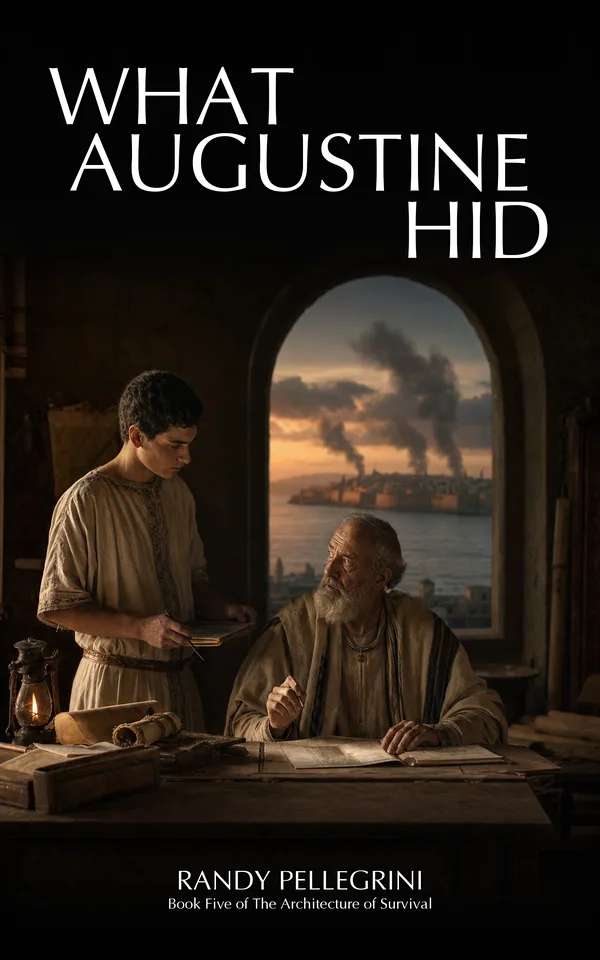
4. What Augustine Hid by Randy Pellegrini (2026)
Mine, and here is where it sits.
Hippo Regius, 410 CE. Augustine is fifty-six, twenty-three years a bishop, and the refugees from the sack of Rome have begun arriving at his gate asking where his God was. A dying courier is dropped at the basilica carrying a papyrus older than the empire, a document that has predicted, with awful accuracy, the fall of every civilization before this one. Augustine recognizes the handwriting of a network his mother taught him to watch for, the one he has carried a piece of bronze for since the night she died at Ostia.
He has twenty years before the Vandals cross from Spain and twenty years to decide what cannot be allowed to burn. The sack, the refugees, the siege of Hippo and Augustine's death in the third month of it are all history. The papyrus and the network are mine, and what he hides inside The City of God is the premise of the book. Possidius, who was there, records that the church library survived the siege. I started from that sentence.
5. The Lantern Bearers by Rosemary Sutcliff (1959)
Aquila is a young officer in Britain when the order comes to withdraw the last troops to the continent. He deserts, stays, and lights the beacon at Rutupiae one final time as the ships leave. Then the Saxons come, and the book becomes the story of what a Roman does when there is no Rome to be Roman for.
Sutcliff wrote it for young readers and won the Carnegie Medal, and adults who come to it late tend to be angry nobody told them sooner. The title is the thesis: someone has to carry a light through the dark years, even if the light is small and nobody is coming to relieve them.
6. The Winter King by Bernard Cornwell (1995)
Arthur, with the magic drained out and the mud left in. Cornwell's Britain is the generation after Sutcliff's: the villas are roofless, the roads are breaking up, the Saxons hold the east, and a warlord named Arthur is trying to hold a kingdom together with Roman methods and no Roman money. Derfel, a Saxon-born warrior who ends his life as a monk, tells it.
Cornwell has said this trilogy is his own favorite among his books, and it is easy to see why. It is the post-Roman world as it probably was: small, violent, Christian and pagan at the same table, and still haunted by the idea that things were once organized.
7. The Death of Attila by Cecelia Holland (1973)
Attila dies in 453, on his wedding night, of a nosebleed, and the empire he held together by force of personality breaks apart within a year. Holland tells it through a Hun named Tacs and a Gepid named Dietric, two men on opposite sides of the collapse who have to decide what they are now that the thing that defined them is gone.
Holland is the most underrated historical novelist in English, and this is one of her best: short, hard, and completely uninterested in making the barbarians either noble or monstrous. The Romans barely appear. That is the point. By 453 the Romans were a rumor on the other side of the Danube.
8. The Last Legion by Valerio Massimo Manfredi (2002)
Romulus Augustulus, the boy whose deposition in 476 is the date in the textbooks, is rescued from captivity by a handful of loyal soldiers and spirited to Britain with a legendary sword, and the novel turns into an origin story for Arthur. It is pulp, and Manfredi knows it. The 2007 film with Colin Firth is worse than the book and should be avoided.
I include it because it is fun and because it is honest about something the serious novels sometimes miss: the last emperor was a child, nobody fought for him, and the people who cared most about the empire at the end were soldiers from the provinces who had never seen Rome.
9. Raptor by Gary Jennings (1992)
Thorn, born intersex and raised in a monastery that does not know what to do with him, becomes a soldier, a spy and a confidant of Theodoric the Ostrogoth as the Goths take Italy in the 480s and 490s. It is nine hundred pages, it is frequently obscene, and Jennings researched it the way he researched Aztec, which is to say obsessively.
This is the fall from the barbarian side, told by a narrator who belongs to no category, in a world where Romans and Goths are learning to live in the same cities under a king who wants to be an emperor and knows he cannot say so. Not for everyone. For the readers it is for, there is nothing else like it.
10. Hypatia by Charles Kingsley (1853)
Alexandria, 415. The philosopher Hypatia teaches mathematics and Plato to a city coming apart between its bishop, its prefect and its mob, and in March she is dragged from her carriage by Christian zealots and killed. Kingsley was a Victorian clergyman with an anti-Catholic axe to grind, and the book is preachy, dated and occasionally absurd.
It is also the only major novel about an event that happened in Augustine's lifetime, a few hundred miles from his church, and that tells you more about what the end of the ancient world felt like than any battle. The 2009 film Agora covers the same ground with a modern sensibility. Read Kingsley anyway. He is a window into how the nineteenth century understood the fall, which is the version most of us still carry.
What the Fall Actually Looked Like
Nobody announced it. The tax rolls kept being compiled, the bishops kept writing to each other, the villas in Gaul kept their mosaics for another two generations. The novels that get the period right understand that collapse is not an event but a long argument among people who cannot agree whether it is happening, and that the ones who saved anything were usually not the ones with armies.
Augustine was dying when the Vandals reached his walls, and his last practical act was to see that the books were kept. That is where mine starts.